Net Metering Application Guide Pakistan
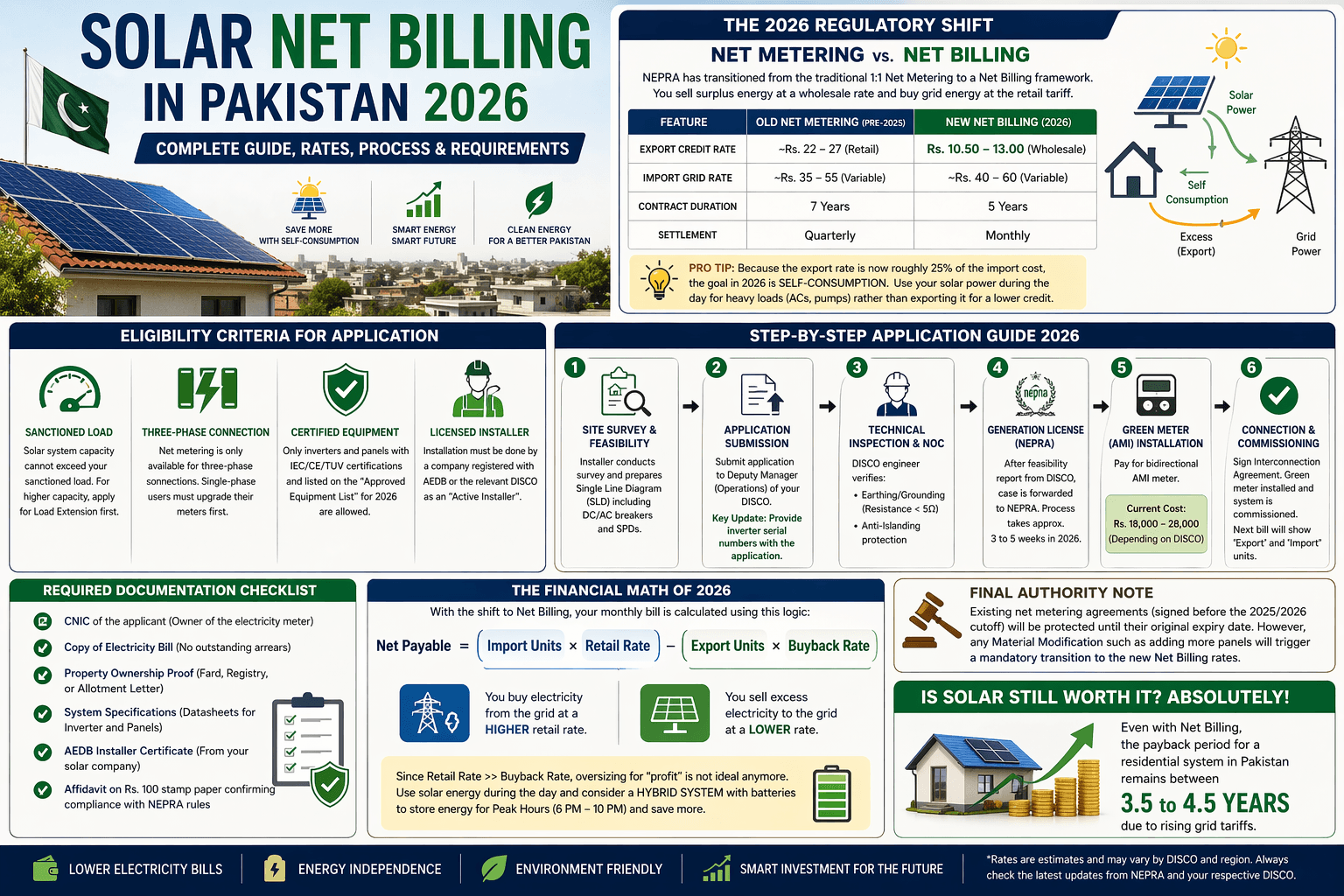
In the evolving energy landscape of Pakistan, 2026 marks a pivotal shift. The National Electric Power Regulatory Authority (NEPRA) has moved from the traditional 1:1 Net Metering model to a Net Billing framework. For homeowners and businesses, this means the "golden era" of simple unit-swapping is evolving into a more nuanced financial game.
Whether you are in the service area of LESCO, K-Electric, IESCO, GEPCO, FESCO, MEPCO, PESCO, QESCO, HESCO or SEPCO understanding the 2026 regulations is non-negotiable before you sign a solar contract.
The 2026 Regulatory Shift: Net Metering vs. Net Billing
Until recently, Pakistan operated on a "Unit-for-Unit" basis. If you exported 1 kWh, you could take 1 kWh back from the grid for free. In 2026, the game has changed to Net Billing.
Under the new NEPRA Prosumer Regulations, you sell surplus energy at a wholesale "buyback rate" and purchase grid energy at the retail tariff.
Rate Comparison 2026 (Estimates)
Feature | Old Net Metering (Pre-2025) | New Net Billing (2026) |
Export Credit Rate | ~Rs. 22–27 (Retail) | Rs. 10.50 – 13.00 (Wholesale) |
Import Grid Rate | ~Rs. 35–55 (Variable) | ~Rs. 40 – 60 (Variable) |
Contract Duration | 7 Years | 5 Years |
Settlement | Quarterly | Monthly |
Pro Tip: Because the export rate is now roughly 25% of the import cost, the goal in 2026 is Self-Consumption. Use your solar power during the day for heavy loads (ACs, pumps) rather than exporting it for a lower credit.
Eligibility Criteria for Application
Before applying, ensure your connection meets these updated 2026 requirements:
Sanctioned Load: Your solar system capacity cannot exceed your sanctioned load. If you want a 10kW system but your meter is sanctioned for 5kW, you must first apply for a Load Extension.
Three-Phase Connection: Net metering is only available for three-phase connections. Single-phase users must upgrade their meters first.
Certified Equipment: NEPRA only approves inverters and panels that carry IEC/CE/TUV certifications and are on the "Approved Equipment List" for 2026.
Licensed Installer: Your installation must be performed by a company registered with the Alternative Energy Development Board (AEDB) or the relevant DISCO as an "Active Installer."
Step-by-Step Application Guide 2026
The application process has been digitized across most DISCOs (Distribution Companies) to reduce "red-tapism."
1. Initial Site Survey & Feasibility
Your installer must conduct a technical survey and produce a Single Line Diagram (SLD). This document shows the safety chain, including DC/AC breakers and Surge Protection Devices (SPDs).
2. Application Submission
The application is typically submitted to the office of the Deputy Manager (Operations) of your DISCO.
Key Update: You must now provide the Serial Numbers of your inverter at the time of application to prevent the use of grey-market hardware.
3. Technical Inspection & NOC
A DISCO engineer will visit your site to verify:
Earthing/Grounding (Resistance must be below 5Ω).
Anti-Islanding protection (The system must shut down during a grid failure for lineman safety).
4. Generation License (NEPRA)
Once the DISCO provides a "Technical Feasibility Report," the case is forwarded to NEPRA for a Distributed Generation License. In 2026, this process takes approximately 3 to 5 weeks.
5. Green Meter (AMI) Installation
After the license is issued, you must pay for a bidirectional Advanced Metering Infrastructure (AMI) meter.
Current Cost: Expect to pay between Rs. 18,000 – 28,000 for the AMI meter, depending on your DISCO.
6. Connection & Commissioning
The final step is the signing of the Interconnection Agreement. Once the green meter is installed, the system is officially commissioned, and your next bill will reflect "Export" and "Import" units.
Required Documentation Checklist
To avoid delays, have these documents scanned and ready:
CNIC of the applicant (Owner of the electricity meter).
Copy of Electricity Bill (Must not have any outstanding arrears).
Property Ownership Proof (Fard, Registry, or Allotment Letter).
System Specifications (Datasheets for Inverter and Panels).
AEDB Installer Certificate (Provided by your solar company).
Affidavit on Rs. 100 stamp paper confirming compliance with NEPRA rules.
The Financial Math of 2026
With the shift to Net Billing, your monthly bill is calculated using this logic:
Net Payable=(Import Units×Retail Rate)−(Export Units×Buyback Rate)
Because the Retail Rate is much higher than the Buyback Rate, oversizing your system purely for "profit" is no longer the best ROI strategy. Instead, 2026 is the year of the Hybrid System. Adding a lithium-ion battery allows you to store your cheap solar energy for use during expensive "Peak Hours" (usually 6:00 PM to 10:00 PM), saving you more money than exporting it to the grid ever would.
Final Authority Note
NEPRA has clarified that existing net metering agreements (signed before the 2025/2026 cutoff) will be protected until their original expiry date. However, any "Material Modification" such as adding more panels to your existing system will trigger a mandatory transition to the new Net Billing rates.
Is solar still worth it? Absolutely. Even with Net Billing, the payback period for a residential system in Pakistan remains between 3.5 to 4.5 years due to rising grid tariffs.
Written by
Abdul Wahab
Abdul Wahab is a solar energy specialist at PakSolarTech with hands-on experience in residential and commercial solar installations across Karachi. All content is reviewed by our certified engineering team.
Learn more about our teamFrequently Asked Questions
More insights about this topic.